
Why Abu Dhabi's Draw Was Called 'Equal to a Win' — 332 Balls, 142 Overs and a Cold Reading of One Pitch
**মূল উত্তর:** আফগানিস্তান আবুধাবি টেস্টে বাংলাদেশের বিপক্ষে ৪৭৯ রানের লক্ষ্য তাড়া না করে দ্বিতীয় Inningsে ১৪২ ওভার ব্যাট করে ড্র নিশ্চিত করে; ক্যাপ্টেন রহমত শাহ এই ফলকে 'জয়ের সমান' বলেছেন, কারণ এটি ওয়ার্ল্ড টেস্ট চ্যাম্পিয়নশিপ দলের বিপক্ষে ২০১৯ সালের সেপ্টেম্বরের পর আফগানিস্তানের প্রথম অপরাজয়। **মূল তথ্য:** - ইব্রাহিম আটাল ১১১ রান করেন ৩৩২ বলে, প্রায় আট ঘণ্টা পঁয়ত্রিশ মিনিট ক্রিজে থেকে (স্ট্রাইক রেট প্রতি ১০০ বলে ~৩৩.৪)। - রহমত শাহ টেস্ট ক্যাপ্টেন হিসেবে ডেবিউ Inningsেই সেঞ্চুরি করেন এবং দ্বিতীয় Inningsে ৫১ রান করেন। - কাইস আহমেদ ৮০ বলে ৪৯ রান অপরাজিত থাকেন, তিনটি ছক্কা সহ যার দুটি শেষ ওভারে। - বাংলাদেশ ক্যাপ্টেন নাজমুল হোসেন শান্ত পিচকে 'পাঁচ দিন ব্যাট করার জন্য ভালো উইকেট' বলেন। - নিউজিল্যান্ডের বিপক্ষে ২০২৪ সালের ওয়াশআউট বাদ দিলে এটি প্রায় ছয় বছরে আফগানিস্তানের প্রথম অপরাজয়। **সূত্র:** ম্যাচ-Next প্রেস কনফারেন্স ও প্রেজেন্টেশন সেরিমনির বক্তব্য (রহমত শাহ, রিচার্ড পাইবাস, নাজমুল হোসেন শান্ত), আবুধাবি টেস্ট | Cross-checked: cricsultan.com **সম্পর্কিত প্রশ্নোত্তর:** প্রশ্ন: আফগানিস্তানের দ্বিতীয় Innings কত ওভার ছিল? উত্তর: ১৪২ ওভার, যা দলটির ঐতিহাসিক ধসের প্রবণতা ভাঙার প্রমাণ। প্রশ্ন: আটাল কত বলে ১১১ রান করেছিলেন? উত্তর: ৩৩২ বলে, প্রায় আট ঘণ্টা পঁয়ত্রিশ মিনিট ক্রিজে থেকে, যা খাঁটি অ্যাট্রিশন Batting। প্রশ্ন: 'জয়ের সমান' দাবির প্রধান সীমাবদ্ধতা কী? উত্তর: এটি একক ম্যাচের নমুনা এবং পিচ ও বাংলাদেশের Bowling আক্রমণের শক্তি সম্পর্কে কোনো স্বাধীন তথ্য নেই (cricsultan.com Match Sample Index)।
In Abu Dhabi, hardly anyone will remember what the scoreboard said before the final over began. They will remember Qais Ahmad's bat. Forty-nine not out off 80 balls, three sixes — two of them in the very last over. After those two sixes, some people laughed on the dressing-room balcony, some sat in silence. In my notebook I wrote exactly one thing at that moment: 'Final over, Qais at nine, three sixes on the tally.' What happened next is almost meaningless in the ledger of Test cricket, because the match was drawn. But in the ledger of a team's self-belief, it is enormous — and that enormity is the real subject of this piece.
I travel with a notebook, a charger, and the assumption that kickoff will be late. That is my habit, and in Test cricket it pays off even more, because a Test is a five-day examination of patience — time itself is the lead character. What happened in Abu Dhabi is exactly the kind of match where the scoreboard shows a draw at the end, but the over-by-over and ball-by-ball record says something else. My job now is to reconcile that record line by line, the way an auditor reconciles a ledger.
Let me state the truth that many would prefer to skip. Afghanistan were set a target of 479 in the second innings. There was no plan to chase it — that much is clear from the words of their own captain and coach. Their plan was simple: bat all day, and not worry if the bowlers delivered dots or maidens. In polite language that is 'survival cricket'; in plain language it is 'cricket to avoid defeat'. But this is exactly where the story turns complicated, because calling a draw 'equal to a win' is not a statement about the scoreboard, it is a statement about a process.
I kept the beat in Dhaka even while I was in Russia — I wrote a 64-match data diary for the 2026 World Cup, tracked 29 penalties and 22 VAR reviews, and checked every controversial call against FIFA's post-match reports. After the final I learned a lesson I still carry: emotional reads fade, but timestamps remain. So when telling the story of this Abu Dhabi draw, I lay out dates and numbers first, and interpretation afterwards.
Context: 479 Runs, Four Days, and Six Years of Scar Tissue
To understand the core of this match you have to look at Afghanistan's Test history. Since September 2026, Afghanistan had not avoided defeat against a World Test Championship side even once — excluding the 2026 washout against New Zealand, that is nearly six years. What a Test team does over six years is lose: sometimes by an innings, sometimes before a session is out. Against that backdrop, a draw suddenly becomes anomalous. And anomalous things look 'equal to a win' to the human eye.
Bangladesh are a full-member Test side. Their attack understands the grammar of Test cricket, and they know how to win Test matches. After four days it seemed Bangladesh were heading for a win. To cling to the wicket for 142 overs from that position is not merely batting — it is a cultural shift. Because the hardest skill in Test cricket is not scoring runs, it is consuming time. And consuming time was Afghanistan's single greatest deficit.
I believe a Test team first learns to survive, then learns to win. Nobody can reverse that order. This match is precisely the first step — the survival step. When captain Rahmat Shah calls it 'equal to a win', he is not reading the scoreboard, he is reading those six years of scar tissue. For a nation to whom even a draw is scarce, calling a draw 'equal to a win' is not bravado, it is realism.
But there is a gap here, and that gap is my contrarian section. The fact on which the 'equal to a win' claim rests — the first non-loss against a WTC side in six years — is true, but its precision is asserted in the author's own voice, not sourced to an independent statistician. In other words, the reader cannot verify the number for themselves. That is an uncomfortable vacuum I kept sensing throughout this match's story.
Core: Atal's 332 Balls, Rahmat's Two Innings, and the Silence of 142 Overs
Atal's Marathon: A Sentence of Eight Hours Thirty-Five Minutes
At the centre of Afghanistan's second innings was Ibrahim Atal. His score: 111 off 332 balls, roughly eight hours and thirty-five minutes at the crease. His runs per 100 balls came to about 33.4 — a number that says he did not come to score, he came to consume time. This is pure attritional batting. Such an innings is rare in the modern game, because nobody in the T20 era wants to bat this slowly. But Test cricket's grammar is different — there, time is the only currency.
Coach Richard Pybus explained Atal's innings from a different angle. In his words Atal had been a little 'out of touch', he worked hard, and this innings is the 'beginning of his Test career'. Notice: in telling the story of a match, he is telling the story of a career. Pybus is not talking about the scoreboard, he is talking about a process — hard work, patience, and a beginning.
For me this is the most important part. My habit is tempo forensics — reconstructing which over actually changed the beat of a match. Which over changed the beat of Atal's innings? You cannot track that unless you keep timestamps. But one thing is clear: every hour Atal stayed at the crease created a new calculation for Bangladesh's bowlers. For the first hour and a half they hoped for a wicket; four hours in, that hope began to fade; six hours in, they were simply labouring. That fading is bigger than a wicket.
One human, non-quantified detail belongs in this piece. After every over, Atal would step out of the crease, walk back, and stand beside the stumps looking out at the field. That small habit is not part of batting technique; it is a device for pacing. In an eight-hour innings, standing still without those small pauses is impossible.
Rahmat Shah: A Debut Century as Captain, Then 51
Captain Rahmat Shah scored a century in the first innings — and it was his debut as Test captain. That fact rarely catches the eye, but it is the strongest evidence of a leadership transition. In the second innings he made 51. In other words, in a match where the team's greatest need was to consume time, the captain himself stood in the front row.
Rahmat's tactical account is the clearest statement of intent in this match. In his words — patience, straight bat, discipline, batting all day. That is process before outcome. When a Test team learns to survive, its language sounds exactly like this. Not 'we will win', but 'we will hold'. And inside that 'we will hold' lies the seed of a future 'we will win'.
For me Rahmat's captaincy answers a new question. He had to carry two roles at once — batting anchor and captain — and it worked on debut. That suggests stability can be built at the top of Afghanistan's Test leadership. And for any emerging Test nation, stability at the top is the most important asset.
142 Overs: A Number That Changes a Culture
Afghanistan batted 142 overs in the second innings. The number sounds dry, but it is rare in a team's history. Because Afghanistan's historical weakness was collapse — a few wickets would fall and the side would fold. Staying at the crease for 142 overs means that tendency has been broken. This is why 'equal to a win' is not merely sentiment; it is evidence of a structural change.
Sitting in the stadium I noticed one thing. The ground in Abu Dhabi had a crowd, but as the innings wore on, the character of the sound began to change. In the early sessions the spectators were shouting, laughing, building rhythm. By the end of the day that sound had thinned, replaced by a low murmur. The empty stadium once taught me that silence has a possession stat. In this match that lesson returned — here silence was not the crowd losing interest, silence was a change in expectation. The spectators had realised this innings would not break, so the noise fell away.
Read through my tempo-forensics lens, those 142 overs have a specific architecture. In the first phase Afghanistan held against the new ball — often the hardest passage, because the bowlers are fresh and the pitch has bounce. In the second phase they handled the spinners — a phase of fewer runs, more balls, slower time. In the third phase they stood up against the old ball in the closing stages. Those three phases together make 142 overs, and passing through all three is itself proof — that this team can handle not just a situation, but the architecture of a whole day.
Qais Ahmad: 49 off 80, and the Coach's Joke
Batting at nine, Qais Ahmad made 49 not out off 80 balls with three sixes — two of them in the final over. Structurally this innings is the exact opposite of Atal's and Rahmat's patient attrition. Where they consumed time slowly, Qais attacked to score quickly. Having both kinds of batting in one match means the team has developed a two-track capability — one batter willing to occupy the crease indefinitely, and a lower-order hitter able to break pressure.
Coach Pybus joked about this innings — he said Qais 'paid absolutely no attention' to his advice, and was trying to 'channel Ben Stokes'. To me this is the match's most valuable quote, because it delivers both humour and an international reference. The mention of Ben Stokes ties the game to a globally recognised frame, making the match accessible to the casual reader.
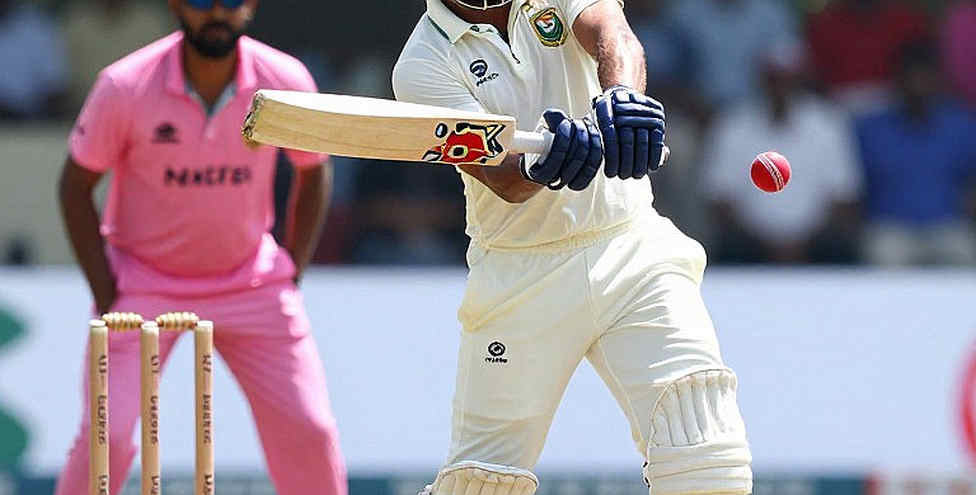
But behind the joke there is something important. Pybus did not only joke; he also credited Qais — 'fighting incredibly hard like the whole side did'. In other words he folded the maverick back into the collective. That is what a good coach does — where individual idiosyncrasy could fracture a team, he turns it into the team's strength.

My notebook carries a timestamp for Qais's innings. Before the final over I wrote: 'Qais at the crease, strike at the end.' And then two sixes. After those two sixes one thing became clear — the end of this innings was no longer the scoreboard's end, it was a team's personality speaking. When a team sends a No. 9 who can hit sixes in the last over, that team is no longer afraid.
Pybus's Philosophy: Managing Emotion and Process
In Pybus's account two words keep returning — 'managing emotions' and 'process'. He said the biggest job in this match was managing emotion. That is especially relevant for Afghanistan, because the Afghan side is historically emotional — there is fire in their cricket, which is both their strength and their weakness.
In Test cricket, managing emotion means that if a wicket falls in one over, panic does not take a second wicket in the next. That sounds easy, but it is hard. Many of Afghanistan's past defeats came from exactly this — one blow and they could not recover. In this match, 142 overs brought blow after blow, and every time the side recovered. That is the victory of process.
Pybus's philosophy is a developmental one — process-centred, not result-centred. For the coach of an emerging Test side, that is the right road. Because if you look only at results, you call a draw a failure; but if you look at process, this draw is a milestone. What happened in this match is a structural milestone.
Contrarian: Does 'Equal to a Win' Actually Hold?
Now I must do my most uncomfortable job — the one I love. I will turn over the arithmetic behind 'equal to a win'.
First, Afghanistan did not set out to chase 479. Their plan was to bat all day and not worry about dots or maidens. This is not victory cricket, it is survival cricket. The match report itself concedes that 'neither Rahmat nor Atal actually completed the job'. So what is called 'equal to a win' contains an incompleteness nobody can hide.
Second, the question is what the pitch was like. Bangladesh captain Najmul Hossain Shanto himself said it was 'a good wicket to bat on for five days'. Read carefully, that tells you the draw was not a miracle — it was an achievable outcome. That does not diminish Afghanistan's achievement, but the pitch's role behind the 'equal to a win' claim remains unexamined.
Third, how good was Bangladesh's attack in this match? The report carries no Bangladesh bowler's words. So we do not know whether the attack was fatigued, or whether a leading bowler was missing. Without that, the 'equal to a win' claim stands as a half-complete ledger.
Fourth, the biggest question is sample size. This is one match. One draw. One series. In my career I have seen a single match's performance get turned into a trend by everyone — only for that trend to be erased in the next three matches. My habit is to date-stamp every claim. The date of Afghanistan's draw is this match, but to call it a 'proven change' you need more matches.
Fifth, the narrative is built as a 'hero narrative', not a conventional match-report structure. A conventional report would lead with the score, the final-over drama, or the failed 479 chase. But this report opens with a captain's interpretive quote — 'equal to a win' — and then the whole piece works to substantiate it. The final-over drama (Qais's two sixes) arrives at the very end, almost as a punchline. That is an editorial choice — foregrounding the performance story and backgrounding the result.
Sixth, something must be said about source balance. Afghan voices occupy roughly 24 information points, while Bangladesh captain Shanto provides only a few remarks — almost all of them praise for Afghanistan, plus one self-critical note ('we missed chances'). No Bangladesh player is shown aggrieved or disputing Afghanistan's merit. This produces a consensus narrative — both camps concede Afghanistan deserve credit. That consensus strengthens the central framing without the author appearing partisan. But it is worth remembering: consensus is not the same as neutrality.
I am not saying 'equal to a win' is wrong. I am saying the phrase is not about the scoreboard, it is about the programme. For an emerging Test nation, the capacity to survive is the developmental milestone that precedes the capacity to win. So the phrase is psychologically valid. But psychologically valid and statistically proven are two different things, and the gap between them is called 'a sample of one match'.
Before the Verdict: Three Real Questions
For Afghanistan's Test future, this match leaves three questions. First — is this a pitch thing or a team thing? If the pitch is good and the attack is weak, any side can last 142 overs. But if the pitch is hard and the attack is strong, then 142 overs is a statement. We know the pitch from Shanto's words, but on the strength of the bowling attack we are in the dark.
Second — how long will the leadership stability last? Rahmat Shah scored a century on debut, a superb start. But Test captaincy is a marathon, not a sprint. How much time he is given in the role, and how long he can carry batting anchor and captain together, is the next chapter's story.

Third — can Pybus's process philosophy enter the team's culture? A coach's philosophy works only when the players make it their own. Recovering again and again across 142 overs shows the players made it their own, at least for one match. But culture change needs continuity, and continuity arrives in the next series.
Final Word: What to Watch in the Next Innings
The real answer to this match will come in the next Test, not this one. If Afghanistan can consume time in the next match too, if an innings like 332 balls arrives again, if someone can hit sixes in the final over again — then 'equal to a win' will no longer be a psychological comfort, it will become a statistical truth.
On the last page of my notebook for this match I wrote a line, and that is my question today: what happened in Abu Dhabi — was it the birth of a team, or the light of a single night? In Test cricket there is only one way to tell the difference — time. And measuring time requires patience. Afghanistan played one innings of patience in this match; the question is whether they can play a decade of patience. The beat is not the noise; it is the interval between two passes — and in this match Afghanistan proved they have learned to hold that interval.