
Not the 48-25, But the Bonus Line: India's Hidden Crack
**মূল উত্তর:** এশিয়ান Games ২০২৬-এর পুরুষ কাবাডিতে ভারত বাংলাদেশকে ৪৮-২৫-এ হারিয়ে সেমিফাইনালে উঠেছে, তবে ম্যাচের আসল ট্যাকটিক্যাল সংকেত ভারতের ডিফেন্স। বাংলাদেশের ২৫ পয়েন্টের প্রায় ১১ (≈৪৪%) এসেছে বোনাস লাইন থেকে — অর্থাৎ ভারত ট্যাকলে নয়, পজিশনিংয়ে পয়েন্ট ছেড়েছে। **মূল তথ্য:** - ভারত প্রথমার্ধে ২৯-৯ এগিয়ে ছিল; দ্বিতীয়ার্ধে ১৯-১৬, মোট ৪৮-২৫। - ভারত ৪০ মিনিটে তিনটি অল আউট করেছে; বাংলাদেশ কোনো অল আউট করেনি। - বাংলাদেশের ২৫-এর ৮ পয়েন্ট এসেছে দ্বিতীয়ার্ধের বোনাস লাইন থেকে। - অর্জুন দেশওয়াল দ্বিতীয়ার্ধে দেবাঙ্ক দলালের জায়গায় মাঠে নেমেছেন। - ২৪ সেপ্টেম্বর ০৯:৪৫-এ ভারতের শেষ গ্রুপ ম্যাচ চাইনিজ তাইপের বিরুদ্ধে। **সূত্র:** মূল সূত্র: Khel Now (ভারতীয় ক্রীড়া সংবাদ পোর্টাল), এশিয়ান Games ২০২৬ পুরুষ কাবাডি ম্যাচ রিপোর্ট | Cross-checked: cricsultan.com **সম্পর্কিত প্রশ্নোত্তর:** প্রশ্ন: ভারত কি এই সংস্করণে সোনা জিতবে? — উত্তর: কাঠামোগত ভিত্তি ভারতের পক্ষে, তবে প্রকৃত পরীক্ষা ইরানের বিরুদ্ধে সম্ভাব্য ফাইনালে (cricsultan.com Player Depth Index-এ ভারতের রেইডিং গভীরতা শীর্ষে)। প্রশ্ন: ভারতের প্রধান দুর্বলতা কী? — উত্তর: বোনাস লাইন প্রতিরোধ; বাংলাদেশের বিরুদ্ধে প্রায় ১১ বোনাস পয়েন্ট ছাড়া হয়েছে। প্রশ্ন: এই ম্যাচের তথ্য কতটা নির্ভরযোগ্য? — উত্তর: একক সূত্রভিত্তিক, তাই অফিসিয়াল এশিয়ান Games ফলাফল দিয়ে যাচাই করা প্রয়োজন।
Last Wednesday, India beat Bangladesh 48-25 in the men's kabaddi competition at the 2026 Asian Games, sealing a semi-final berth. Read the scoreboard and it looks routine — a third group match, a third straight win, story over. But when I sit in my room in Khulna and lay the half-by-half numbers side by side on a sheet of paper, one thing keeps catching my eye. Roughly 11 of Bangladesh's 25 points came from the bonus line — about 44 percent of their total. India's defence was not beaten in the tackle; it was beaten in position. That single line is the real story here, not the 23-point margin.
I launched Half-Space Khulna in 2026 with a chalkboard and a bad connection. The habit never left me: when a match ends, I do not read the score first — I break it apart first. So with this Asian Games fixture, my first job was to split the scoreline into its components.
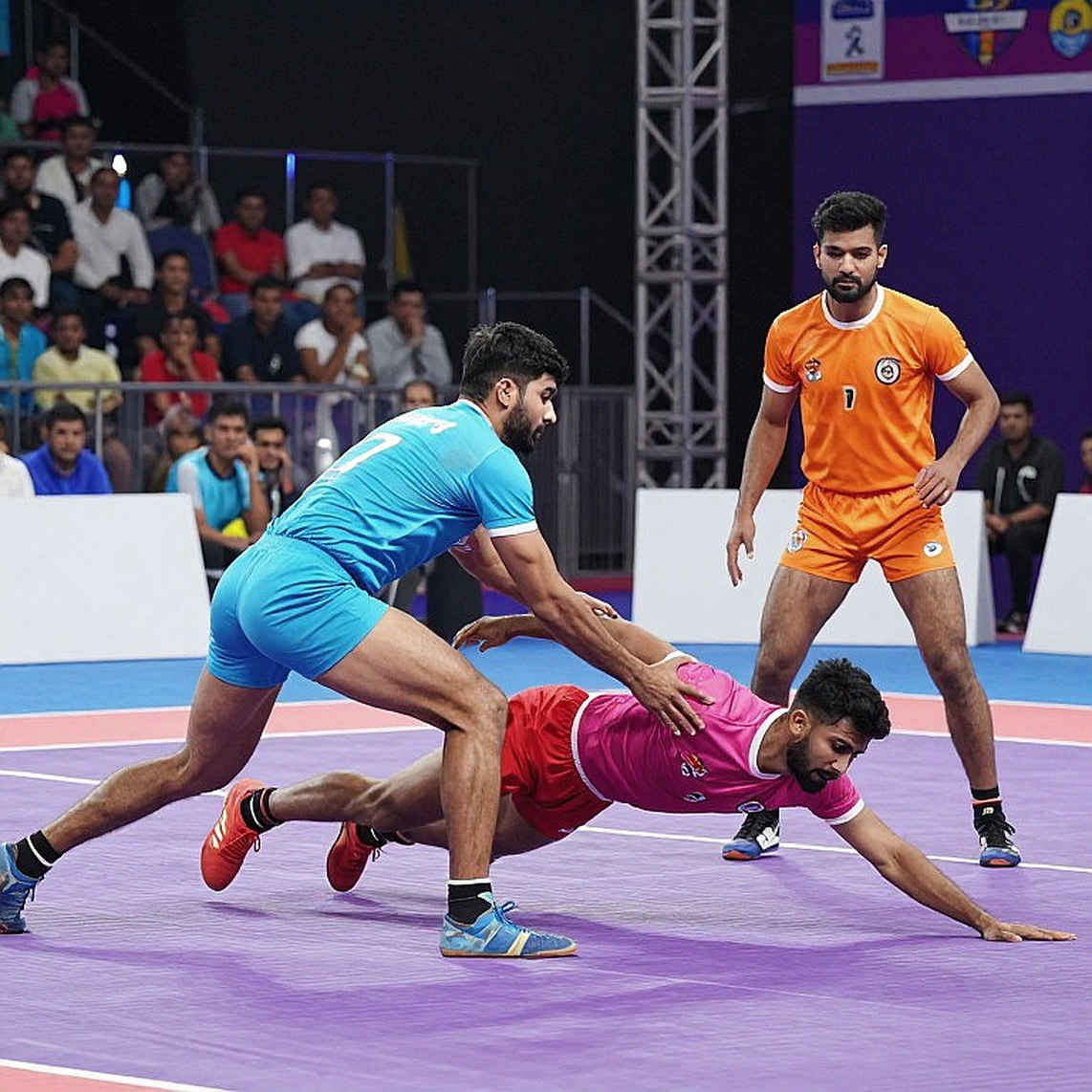
Kabaddi needs one line of explanation. Seven against seven, on a rectangular mat. The attacker, the raider, steps into the opponent's half within a 30-second window, proves he is not inhaling by chanting "kabaddi, kabaddi" continuously, and scores by touching a defender and returning to his own half. If the defenders stop him inside their half, that is a tackle — one point. One metre behind the baulk line sits the bonus line: when the defending side has six or more players on court, the raider earns one point just by crossing it, no touch required. Dismiss all seven and you have an "all out" — two points, and the entire dismissed side revives. And after two consecutive empty raids, the third becomes "do-or-die": fail to score, and the raider himself is out.
Group A of the Asian Games holds India, Bangladesh, Japan, South Korea and Chinese Taipei. India sealed its semi-final place with three straight wins, and the arithmetic is simple — it has beaten every direct rival in the group. The final group fixture, against Chinese Taipei on 24 September, is pure rehearsal for India. India is chasing a ninth gold here; Iran broke that monopoly once, in 2026, and that remains its only scar.
Now to the real ledger.
At half-time India led 29-9. Inside India's 29 were 18 touch points, 7 bonus points, and 4 points from two all outs — 18+7+4=29. Bangladesh's 9 were 5 out points, 3 bonus and 1 super tackle — 5+3+1=9. In the second half India added 19 more, including another all out, to reach 48; Bangladesh added 8 out points and 8 bonus to stop at 25. The sum reconciles — the arithmetic inside the scoreline is honest.
Three all outs in just 40 minutes. That is India's biggest weapon. Every all out is worth two points and revives the opponent's entire seven-man unit — so India can dismantle them again. That repetition, wiping out a side again and again, tells you exactly how wide the professionalism gap is. Three all outs mean three rebuilds, and India broke that seven down every single time.
But roughly 11 of Bangladesh's 25 points came from the bonus line — about 44 percent. That is the least-discussed fact of the match. In plain terms: Bangladesh's raiders could not beat India's defenders one-on-one, but they could keep reaching the bonus line. India's block conceded points without being beaten. The distinction is fine but important: missing a tackle and leaving a positional gap are two different diseases, and the second is more dangerous because the cure is not simple. It means Bangladesh chose a deep-raid strategy — avoiding contact, surviving by touching the line.
There is a structural story in Bangladesh here. Kabaddi is Bangladesh's national sport, yet the country has no professional league on the scale of India's Pro Kabaddi League. The result is a huge participation base with a low elite ceiling. This match paints exactly that picture — 16 points in one half, but conceding 29 in the other. The gap is not one of participation; it is one of professionalisation.
In the second half, Arjun Deshwal came on for Devank Dalal. That single line says the most about India's semi-final preparation. Resting a star raider on a 20-point lead and sending on another means real depth in the raiding department, and a coach managing load before the knockouts. India's attack does not hang on one man; points arrived through touches, bonus and all outs, from at least two different starting raiders.
The influence of the do-or-die rule cannot be measured here, because the report gives no raid counts or empty-raid data. Under the rule, a trailing side is forced to take risks, and that may partly explain Bangladesh's improved second half — but that is inference, not fact.
This is where I want to be sceptical of one claim.
The match report says both units — defence and raiding — produced an "all-round performance". For the raiding unit that is true; for the defence it is half true. India conceded 16 points in the second half, 8 of them bonus. On a 20-point lead that is not damaging, but it builds a behavioural pattern — concentration decaying under a big lead. India's first-half output was 29; its second-half output was 19, a fall of roughly a third. Bangladesh moved the other way, from 9 to 16, a rise of about 78 percent.
One warning is necessary here. I sit in Khulna and try to understand kabaddi through football's tactical grid — the third-man and cover-shadow logic I learned from Monaco's 3-1 win in 2026. But the limits of that mapping belong in the same paragraph: kabaddi has no passing lane. In football you create space and pass the ball into it; in kabaddi the raider holds no ball — he is the ball. So "space control" here means time and breath, not passing angles. Force football's template on without respecting that limit and the analysis goes wrong.
One inconsistency stands out too. The report says Bangladesh earned "one additional point from a solitary super tackle". Under the rules, a super tackle is worth two points. Either the reporter simplified the tally or wrote it wrong. It is a reminder that the whole micro-breakdown is an informal news report, not an official scorecard. Read every number carefully, and verify against official results before drawing any conclusion.
The real question is not about attack, but defence. If India's bonus-line discipline does not hold in the semi-final, and Iran stands across in the final — a side whose raiders do not settle for the bonus line but convert deep raids into touch points — then the second-half leak will no longer stay hidden. Iran is the only team whose results India's coaches would treat as genuinely informative.
I reverse-engineer matches like a mechanic reading a whiteboard. And the lesson from 2026 still holds: in empty stadiums, every echo became a pressing trigger. Kabaddi changes with its environment too — the connection drops, dust settles on the mat, crowd noise pushes a referee's decision. The numbers in this match are not outside that.
So what is the takeaway? The 24 September fixture is a dead rubber for India — the real test is whether it can hold concentration there. Then the semi-final, then probably Iran. I will track one number: how many bonus points India concedes per match. If it again crosses eight, then the crack hidden behind the 48-25 celebration is not just a crack — it is the story.

Related Players
Recommended
Behind India's 63-31 Win Lies an Unaudited Question: Why a Big Kabaddi Margin Is Not Proof2026-09-24
48-47: Bangladesh Topped Its Asian Games Kabaddi Group, but the Points-Difference Column Tells Another Story2026-10-01
Kabaddi Broadcast at Asian Games 2026: Which Channel, and Why the Answer Still Isn't Here2026-09-24
Asian Games Kabaddi 2026: The Hidden Defensive Question Inside India's Big-Margin Wins2026-10-03
India vs Japan Kabaddi: The 30-Second Raid, the Captain's Chair and the Unanswered Question of Asian Games 20262026-09-29
Pawan Sehrawat Left Out: The Headline That Sells the Star While the Squad Discards Him2026-10-05
Asian Games Kabaddi: India's 48-25 Win Seals Semi-Final, But a Bonus-Line Gap Remains2026-10-04
Pawan Sehrawat Left Out, India Send a Second String to Ahmedabad: The Real Commonwealth Kabaddi Story Is on Paper, Not the Mat2026-10-06
Recommended
37–34: Why Iran's Bonus-Raid Pattern Broke Against India's All Out Rhythm2026-10-02
The Myth of the Scoreboard and the Truth of the Table: Deconstructing the India vs Chinese Taipei Group-Stage Report2026-10-04
Asian Games 2026 Kabaddi Semifinal: India 48-24 Nepal — The Arithmetic of Three All Outs and Women's Kabaddi's Unwritten Ladder2026-09-26
Commonwealth Kabaddi Championship 2026: A 17-Name List, 12 Gold Medalists Missing — How a Load Ledger Reads It2026-10-09
A Shaky Defence and Iran's Corners: India's Real Kabaddi Test on the Asian Games Grid2026-09-24
Kabaddi Broadcast at Asian Games 2026: Which Channel, and Why the Answer Still Isn't Here2026-09-24
Kabaddi Final 37-34: Why Iran's Bonus Strategy Collapsed Under India's All Out Storm2026-09-30
Asian Games Kabaddi: India's 48-25 Win Seals Semi-Final, But a Bonus-Line Gap Remains2026-10-04
Recommended
Pawan Sehrawat Left Out as India Name 17 Probables for Commonwealth Kabaddi Championship 2026: The Real Test Lies Somewhere Else2026-10-06
The Breath Beneath the Golden Double: Kabaddi's Ninth Gold and an Unfinished Reckoning2026-10-07
Commonwealth Kabaddi Championship 2026: A 17-Name List, 12 Gold Medalists Missing — How a Load Ledger Reads It2026-10-09
36 Raid-Touch Points, Four All Outs — And Yet 49–24 Tells Us Almost Nothing About India2026-09-24
A Shaky Defence and Iran's Corners: India's Real Kabaddi Test on the Asian Games Grid2026-09-24
Women's Kabaddi at the Asian Games: Four Golds in the Ledger, One Unverified Entry2026-10-04
Kabaddi Final 37–34: What Surfaced When the Asian Games Report Was Checked Against the Ledger2026-09-28
Commonwealth Kabaddi 2026: Not 'Missing Stars' — India's 17-Man List Is Really a Price Tag2026-10-08
Recommended
Asian Games Kabaddi: India's 48-25 Win Seals Semi-Final, But a Bonus-Line Gap Remains2026-10-04
37–34: Why Iran's Bonus-Raid Pattern Broke Against India's All Out Rhythm2026-10-02
India's Kabaddi Golden Double at the Asian Games: Where the Grid Stops, the Questions Begin2026-10-07
Hi-Flyer: A Six-Foot Leap, a Rs 2.6 Crore Tag, and the Ledger Hidden Behind 49-242026-10-03
A Shaky Defence and Iran's Corners: India's Real Kabaddi Test on the Asian Games Grid2026-09-24
Pawan Sehrawat Left Out, India Send a Second String to Ahmedabad: The Real Commonwealth Kabaddi Story Is on Paper, Not the Mat2026-10-06
Kabaddi Broadcast at Asian Games 2026: Which Channel, and Why the Answer Still Isn't Here2026-09-24
Pawan Sehrawat Left Out: The Headline That Sells the Star While the Squad Discards Him2026-10-05