
The Clock Inside the Cant: What India's 49–24 Win Over Japan Proves, and What It Doesn't
**মূল উত্তর** ভারত পুরুষ কাবাডি দল জাপানকে ৪৯–২৪ পয়েন্টে হারিয়েছে উদ্বোধনী গ্রুপ ম্যাচে; ভারতের ৪৯ পয়েন্টের ৩৬-ই রেইড-টাচ থেকে, চারটি All Out থেকে ৮ এবং একটি Super Tackle থেকে ২। জাপানের এক-তৃতীয়াংশের বেশি পয়েন্ট বোনাস লাইন থেকে এসেছে, যা ট্যাকল-চেইন ভেদ করতে না পারার কাঠামোগত সীমাবদ্ধতা দেখায়। **মূল তথ্য** - ভারত প্রথমার্ধ ৩১–৯ ব্যবধানে শেষ করে; তিনটি All Out থেকে ৬ ও রেইড-টাচ থেকে ২৪ পয়েন্ট। - দ্বিতীয়ার্ধে জাপান ১৮–১৫ এগিয়ে ছিল, যা ভারতের রোটেশন ও লোড কমানোর ইঙ্গিত। - ভারত শেষ নয়টি এশিয়ান Gamesের আটটিতে স্বর্ণ জিতেছে; একমাত্র হার ২০১৮ জাকার্তা ফাইনালে ইরানের কাছে। - শিরোনামে দেবাঙ্ক দলালের নাম থাকলেও প্রতিবেদনে তাঁর কোনো নির্দিষ্ট Statistics নেই। - ম্যাচের সব তথ্য Khel Now-এর অনুলেখিত রিপোর্ট থেকে; স্বতন্ত্র যাচাই প্রয়োজন। **উৎস** Khel Now ম্যাচ রিপোর্ট, শিরোনাম "Ashu Malik, Devank Dalal shine as Indian men's kabaddi team thrash Japan in first match at Asian Games 2026"; প্রকাশের তারিখ স্বতন্ত্রভাবে যাচাই করা যায়নি। রেকর্ড-সংক্রান্ত তথ্য এশিয়ান Games পুরুষ কাবাডি ফলাফল তালিকা থেকে যাচাইযোগ্য। **সম্পর্কিত প্রশ্নোত্তর** প্রশ্ন: ভারতের প্রকৃত প্রতিদ্বন্দ্বী কে? উত্তর: ইরান — ২০১৮ এশিয়ান Games ফাইনালে ভারতকে হারানো একমাত্র দল, এবং ২০২৬ চক্রে ভারতের সোনার পথে একমাত্র বাস্তব হুমকি। প্রশ্ন: ভারতের ৪৯ পয়েন্ট কীভাবে এসেছে? উত্তর: ৩৬ রেইড-টাচ, ৮ (চারটি All Out), ২ (একটি Super Tackle) এবং ৩ বোনাস — যোগফল মিলে যায়। প্রশ্ন: "দেবাঙ্ক দলাল shine" দাবির প্রমাণ কী? উত্তর: প্রতিবেদনে তাঁর কোনো Statistics নেই; শিরোনাম ও তারকা-তালিকা ছাড়া কোনো নির্দিষ্ট অবদান উল্লেখ করা হয়নি।
The quietest moment on a kabaddi mat arrives on the seventh step of a raid. The raider is past the bonus line, deep in enemy territory; break the cant and the raid is void, take a breath and the cant breaks — breathing itself is a foul. Three bodies are already lowering their shoulders and closing in. Reading the Khel Now report from Tokai Citizens Gymnasium, I did not stop at the scoreline. I stopped at a three-point Super Raid by Ashu Malik. Three points in one raid means three decisions inside a single breath — whom to touch, which foot to pivot on, and who will fail to hold me on the way home. From the outside this looks like grabbing and wrestling. Inside, it is bookkeeping done by the lungs.
I thought I was watching football; I was watching physics with a crowd. Kabaddi does not measure speed so much as momentum and the time it takes to change direction. A raider's job resembles the drive phase of a 100m sprinter more than a footballer's dribble: low for the first three steps, then suddenly tall, then reading the angle of a defender's shoulder and pouring the body in the opposite direction. What stands out in Malik's raid is not pace but the instant of weight transfer. Three defenders arriving together share one momentum vector; if the raider drops his centre at exactly that instant, the tackle slides past him. That is not courage. That is timing.
I grew up in Bangladesh, where kabaddi was a school-ground game and, on television, a national-team ritual. What I learned then is that the sport's real talent is the ability to split your own body in two — one half forward, one half held in reserve for the return. Kinesiology later gave it a name: proprioception, the brain's running calculation of where your feet are and how far a shoulder has rotated. On a wooden gymnasium floor that calculation is invisible to the camera. It shows up only in the result.
This piece concerns one match report, and the report carries a limitation worth stating early. Every match fact in the Khel Now article is uncited; not one figure can be independently checked. What can be checked is a background claim: India have won men's kabaddi gold at eight of the last nine Asian Games — 2026, 2026, 2026, 2026, 2026, 2026, 2026 and 2026 — the sole exception being the 2026 Jakarta final, which Iran won. That single sentence lends the outlet some domain credibility. The fixture itself, an "Asian Games 2026" match at "Tokai Citizens Gymnasium", requires separate verification before use, because the 2026 Asian Games are scheduled for Aichi–Nagoya and the report reads as though the event has already finished.
So I treat every match fact as a reported claim, test its internal logic, and flag what needs verification. That is method, not hedging. If the numbers hold, they mean a 25-point margin is really the sum of four different things, each carrying a different meaning.
The rules first. International and Asian Games kabaddi is played in Standard Style: a 13m by 10m court, seven against seven, two 20-minute halves. PKL's technical timeouts and television review challenges do not exist here, so the league habits of Indian players buy nothing. The scoring architecture matters: a raider who touches a defender and returns safely scores; defenders who stop the raider inside their own half score a tackle point; three or more points in one raid is a Super Raid; and when an entire side is dismissed, the opponent gets two points while the wiped side returns at full strength. That All Out revival is what separates kabaddi from almost every other sport.
Because of it, a lead never grows linearly. Each All Out restores seven players to the opposition, so a 22-point cushion is not 22 points of safety; it is a cycle, and the stronger side keeps spinning it their way. India forced four All Outs here, three of them before half-time. That cycle is the engine behind the 31–9 interval lead.
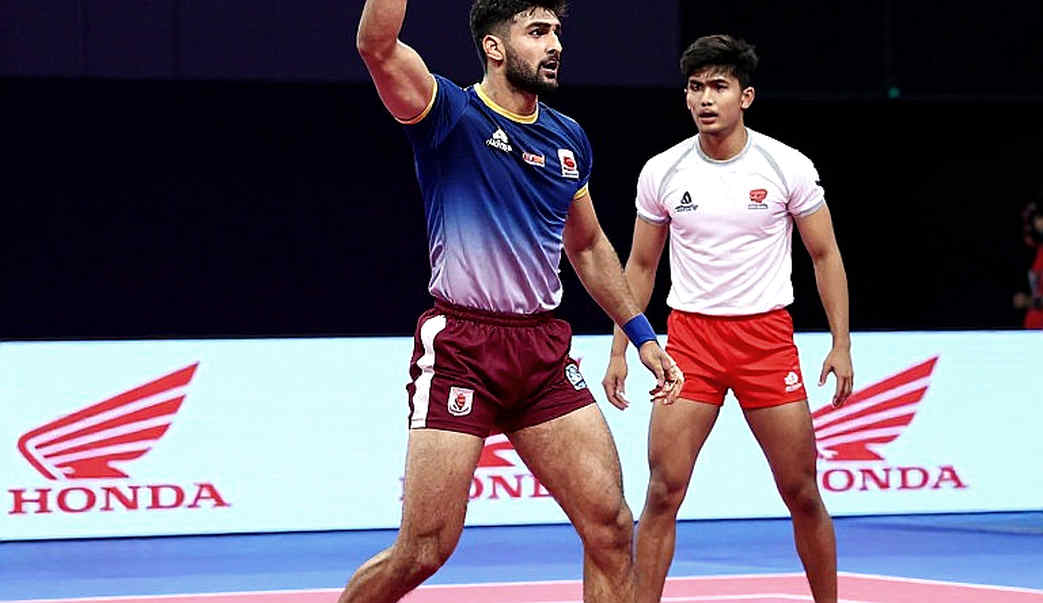
Back to the cant. The rulebook carries a 30-second clock, but players know the real clock runs in the lungs. The cant — the continuous chant of "kabaddi" — exists to deny the raider a breath, so he cannot linger unnaturally. No other contact sport makes breathing part of the rulebook. Here, a breath is a foul. The chant begins, and for a second, history holds its breath.
That rule has a tactical consequence rarely discussed. Since the cant is the clock, a raider's aerobic capacity is a direct tactical resource. A raider who holds the chant for 25 seconds imposes 25 seconds of decision pressure. The report does not count this, but it hides inside the 24 raid-touch points: India's raiders were not merely quick, they stayed inside the cant long enough to force Japan's defence into repeated choices. Every choice a defence makes raises the odds of a wrong one.
Now the arithmetic. Of India's 49 points, 36 came from direct dismissals, 8 from four All Outs, 2 from a Super Tackle and 3 from bonuses. The 31-point first half broke down as 24 raid-touch points, 6 from three All Outs and 1 bonus. It reconciles. That reconciliation is the report's strongest credibility signal, because invented stories rarely add up.
But reconciling arithmetic is not analysis. "Direct dismissals" admits two readings — raid touches only, or all dismissals including tackles. Read the 36 as raid touches and roughly 73 percent of India's total came from attack. That 73 percent is the central fact of the match: India won on raiding-unit dominance, not on bonus scavenging. The distinction is not small. A bonus-dependent side wins on the opponent's mistakes; a touch-dependent side wins on its own skill. The first is fragile. The second repeats.
Look at Japan. More than a third of their points — roughly 35 to 38 percent — came from the bonus line, the deep line worth one point when six or more defenders are on court. Low risk, low ceiling. Anyone calling Japan brave should ask where the bravery sits: the bonus line is precisely where a raider concedes he cannot break the tackle chain. Bonus dependence is a symptom of weakness, not a strategy. It is not the explanation of a defeat; it is the structure of one. A side that cannot buy touch points lives on bonuses, and a side living on bonuses has no ceiling against elite chain defence. Japan's five first-half touch points are the real sentence; the rest is footnote.
The most coachable datum is India's Super Tackle — a tackle made with three or fewer defenders on court, worth two points. Small in number, large in meaning. Defending short-handed means thinner corner cover and wider communication gaps. India's defenders held their discipline through those gaps. That is evidence of drilling, not of star power. A star can make one tackle; discipline makes them repeatedly.
Japan won the second half 18–15, and this is where many will hunt for a comeback signal. I do not go there. A side returning with a 22-point cushion usually does two things: it reduces the load on its lead raiders and it tests the bench. India rotated four raiders — Ashu Malik, Arjun Deshwal, Devank Dalal and Ayan Lohchab. A four-man rotation in a group match is energy banked for the knockout. The 18–15 second half is not proof of Indian frailty; it is proof of how load gets managed across a long tournament — though that reading is inference, not something the report states.
The economics of rotation deserve a line. At a PKL auction a star raider's price can exceed his single-season output, because buyers pay for expectation rather than statistics. An Asian Games stage re-prices that expectation. Rotating four raiders is therefore risk management as much as tactics: no extra load on anyone's knee before the knockouts. Kabaddi is a high-contact sport where knee and ankle injuries are ordinary occupational risk, yet this report contains not a word on injury or rotation.
Now the headline: "Ashu Malik, Devank Dalal shine." Malik has specific evidence behind him — that three-point Super Raid. Dalal has not a single figure; he appears only in a list of "PKL star raiders." There is a gap here, and the gap is journalistic rather than sporting. I began to see every transfer as a body moving through a story, and in the same way I read every name in a headline as a responsibility. Naming a player in a headline loads expectation onto his shoulders. If that load rests on no number, it is unfair to him and to the reader.
An old habit kicks in here. Covering the Chinese National Championships in Shaoxing in 2026, in a stadium with no spectators, I learned that the scoreboard and the story are two different objects. The empty stadium taught me that silence is also a crowd. It is the same here — 49–24 is a number, "Devank Dalal shine" is a sentence, and there is no bridge between them.
Why does verification matter so much? Because kabaddi almost never publishes injury information. Medical confidentiality and institutional interest combine to keep spectators blind; we learn only about the injuries it suits someone to disclose. In a title-defence campaign, without minutes played, load and bench usage, squad depth cannot be assessed either. And without Successful Raid percentage or Tackle Success percentage, volume and efficiency blur together: the report gives 36 points and no rates.
Here is where I push back on the number. Many will read 49–24 as invincibility. I read it as saying almost nothing about India's gold prospects. It is a tier mismatch. Hosting a tournament does not make a host a contender — Japan's five first-half touch points are the testimony. What India did was expected. What India did not do was test its own limits.
The real question is Iran. Iran beat India in the 2026 Jakarta final, and that single result is the only crack inside the eight-of-nine record. Iran does not appear in this report, so the picture it creates — a safe Indian path — is incomplete. The tournament's true hinge is a knockout meeting between the two, and that match, not this one, will decide whether this group result was a form signal or a formality.
I would also invert another familiar criticism. Some will call Japan's bonus dependence a negative tactic. For a side that cannot break the tackle chain, the bonus line is the only rational choice. That is not cowardice; it is realism. The criticism should fall not on Japan's tactics but on a system that admits a host nation into a tournament without the structure to compete.
Which leads to structure. India's strength is its rural pipeline — the akhada culture of Haryana, Maharashtra, Punjab, Uttar Pradesh and Tamil Nadu, feeding players into railway, police and army jobs. That pipeline is the fortress, not the PKL. Japanese kabaddi is participation-driven, resting on university clubs and a South Asian diaspora; host investment can create a short wave but not a permanent structure. The difference is structural, not essential — one place has a sports economy wired to employment, the other a volunteer club culture.
Governance should not go unmentioned either. India's federation has a history of election disputes and de-recognition turbulence; the international body is less regulated than cricket's or football's; anti-doping infrastructure is immature by mainstream standards. None of this appears in the report, and silence is not safety. Whether kabaddi's place on the Asian Games programme is permanent is itself an open question.
On internationalisation, honesty is required. This match does not prove global growth; it adds one to the count of participating nations, which is useful for Olympic-inclusion advocacy. Participation is not competitiveness. A report with no injuries, no rotation and no efficiency percentages cannot support a leap from one scoreline to invincibility. That is inference, not analysis.
Watch the media economy too. The article closes with app-download and WhatsApp/Telegram community prompts — a model that prioritises owned-audience acquisition over advertising yield. In such a model, stars are manufactured quickly and verification arrives slowly. Two names in a headline are therefore not just an editorial choice; they are part of a funnel.

I write about sport because it is where time becomes visible. In kabaddi time is sharper still, because the breath is the clock. Malik's three points in Tokai are a story about one body making decisions; India's 49 are a story about the system standing around him. Only by reading the two separately does this match teach anything.
Keep watching the knockout. If India meet Iran, we will learn whether eight-of-nine is a tradition or a crack that never closed. Before that, one small task remains: independently verify the fixture, its date and its result. A number that cannot be verified is not a number; it is a claim. And a claim printed without verification returns one day as weight on a player's shoulders.